Chronic UTI: what the evidence actually shows
Chronic UTI describes persistent bladder symptoms attributed to infection that standard tests miss. The underlying biology, bacteria embedded in the bladder wall, is well documented and urine cultures do have real limits, but long term antibiotic treatment is not yet proven in randomised trials, so thorough investigation and specialist led management matter most.
Few topics in urology generate as much frustration as chronic urinary tract infection. Patients, overwhelmingly women, describe years of urinary pain, urgency and frequency, repeatedly told that their tests are normal, cycling between diagnoses and sometimes told the problem is in their head. Online, the same patients find communities and clinics offering long term antibiotic treatment that mainstream medicine does not endorse. Both camps quote science at each other.
This page is my attempt at an honest account of where the evidence stands. I have no product to sell and no camp to defend. My position, set out below, is that these symptoms are real, that our standard tests do miss infection in a proportion of patients, that the science of bacterial persistence in the bladder is solid, and that the treatment evidence, while promising, is not yet definitive. That combination calls for thorough investigation and careful specialist led management, not for dismissal and not for uncritical adoption of any protocol.
What patients mean by chronic UTI
Chronic UTI describes persistent lower urinary tract symptoms, typically pain, burning, urgency, frequency and pressure, continuing for months or years, which patients and some clinicians attribute to a low grade bladder infection that standard tests fail to detect and short antibiotic courses fail to clear. It overlaps with, and is often previously labelled as, interstitial cystitis, painful bladder syndrome or “overactive bladder that never responds to treatment”.
The problem with the standard urine test
The midstream urine culture that underpins UTI diagnosis dates from research on kidney infection in the 1950s. Its famous threshold, 100,000 bacteria per millilitre, was chosen to identify pyelonephritis in pregnant women, not bladder infection in the general population. Applied as a universal cut off, it performs poorly. Studies comparing routine culture against more sensitive methods have repeatedly found genuine bacterial infection in a substantial proportion of symptomatic women whose standard cultures are reported negative; in one frequently cited study using molecular methods, E. coli was detectable in the majority of symptomatic women with negative routine cultures. Dipsticks perform worse still in this setting.
This is not a fringe claim. It is acknowledged in the mainstream literature, and it matters clinically: a negative culture in a woman with persistent urinary symptoms excludes less than most patients, and many clinicians, believe.
Bacteria can hide in the bladder wall
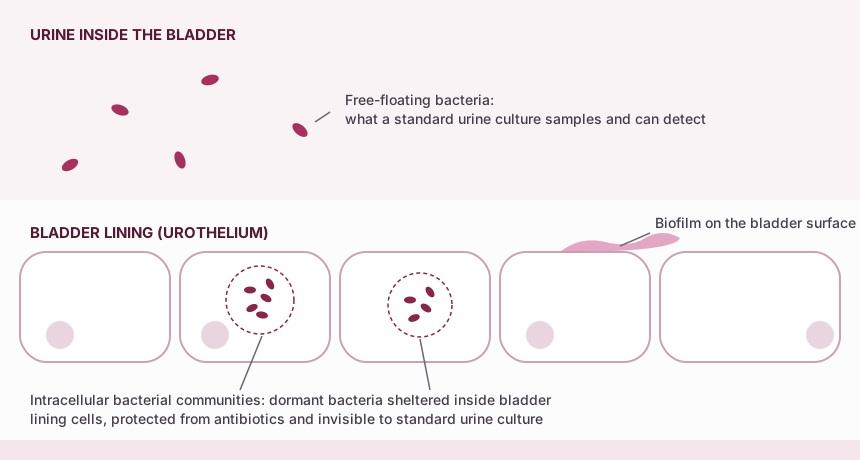
The second well established strand of evidence concerns where bacteria go. Laboratory and human studies over two decades have shown that uropathogenic E. coli can invade the cells lining the bladder, form communities inside those cells, and construct biofilms, in which bacteria live in a dormant, sheltered state. In this state they are largely protected from antibiotics, which work best on dividing bacteria, and invisible to urine culture, because they are not floating free in the urine. Shed bladder lining cells carrying intracellular bacteria have been demonstrated in urine from women with chronic symptoms. This biology offers a coherent explanation for the familiar clinical story: an infection that improves on antibiotics, returns days after stopping them, and eventually stops showing up on tests altogether.
Where the treatment evidence stands
Here the picture is more contested, and honesty matters.
The case for extended treatment rests mainly on observational studies from specialist clinics, the largest following several hundred women with chronic symptoms treated with prolonged antibiotic regimens alongside methenamine, reporting meaningful symptom improvement in a majority. These results are encouraging, and for the women concerned they were often life changing. But observational studies cannot fully separate treatment effect from placebo response and natural fluctuation, regimens varied, and there is, as yet, no completed randomised controlled trial of long term antibiotic therapy for chronic UTI. Extended antibiotic use also carries real costs: side effects, effects on the microbiome, and resistance.
Mainstream guidance reflects this gap. NICE guidance covers acute and recurrent UTI but does not recognise chronic UTI as a distinct diagnosis, and no major urological association currently recommends long term antibiotics for culture negative persistent symptoms. At the same time, the field is moving: the limitations of standard culture are increasingly accepted, the 2025 American urology guideline update on recurrent UTI acknowledges the evolving science of the urinary microbiome, and research groups in the UK and internationally are working on better diagnostics and trials.
In short: the biology is credible, the diagnostic gap is real, and the treatment evidence is promising but incomplete. Anyone who tells you the question is settled, in either direction, is ahead of the data.
What I advise patients caught in the middle
If this is your situation, three principles serve you well.
First, insist on proper investigation before accepting any label. Persistent urinary symptoms have a differential diagnosis, and some of the alternatives matter greatly: bladder stones, urethral problems, gynaecological causes and, rarely, bladder cancer, particularly where there is blood in the urine. A thorough assessment, including cystoscopy where indicated, is the non negotiable first step whatever treatment philosophy follows.
Second, be wary of both extremes. Symptoms dismissed because a culture is negative is poor medicine; so is years of unmonitored high dose antibiotics without investigation, follow up or an exit strategy.
Third, if extended or unconventional treatment is used, it should be specialist led, with a clear rationale, defined review points, monitoring for side effects, and willingness to stop or change course. Uncertain evidence demands more supervision, not less.
How I approach these cases
My practice is investigation first: a detailed history, properly interpreted urine studies, assessment of bladder emptying, imaging and cystoscopy where indicated, to establish what is and is not going on in your bladder. Where infection or inflammation is found, treatment is targeted at it, drawing on the full range of options including antibiotic strategies, bladder instillations to restore the bladder’s protective lining, vaginal oestrogen where relevant, methenamine, and the sublingual UTI vaccine in selected cases. Where symptoms persist and the evidence base is thin, I am open with patients about uncertainty, and we make decisions together, with defined review points. What I do not do is dismiss symptoms because a form reports “no growth”.
Persistent symptoms deserve a proper answer
If you have been living with urinary symptoms that tests keep failing to explain, a thorough specialist assessment is the right next step.
Book a specialist review Or call 0204 558 6750Common questions
Is chronic UTI a recognised diagnosis?
Could my symptoms be interstitial cystitis instead?
Will long term antibiotics cure me?
- Kass EH. Asymptomatic infections of the urinary tract. 1956 (origin of the culture threshold).
- Reassessment of routine midstream culture in diagnosis of UTI; Heytens S et al, molecular detection in culture negative symptomatic women.
- Rosen DA et al. Intracellular bacterial communities in human UTI. PLoS Medicine 2007
- Khasriya R et al. Spectrum of bacterial colonisation in urothelial cells from patients with chronic LUTS. J Clin Microbiol 2013
- Swamy S et al. Recalcitrant chronic bladder pain and recurrent cystitis. Int Urogynecol J 2018
- NICE NG112, recurrent UTI, including methenamine update
- AUA/CUA/SUFU guideline, 2025 amendment
- Harding C et al. ALTAR trial. BMJ 2022
General information, not a substitute for personal medical advice.